

Pizzeria Brandi
The History of Pizza
The history of pizza goes back thousands of years, and its origins can be traced back to the time of the ancient Mediterranean civilisations. However, it was in Naples, the ancient Neapolis, that the speciality found its definitive consecration, establishing itself as a popular dish par excellence. In this context, the Antica Pizzeria Brandi played and still plays a fundamental role as the ‘cradle’ of the most famous of all pizzas: the Margherita.
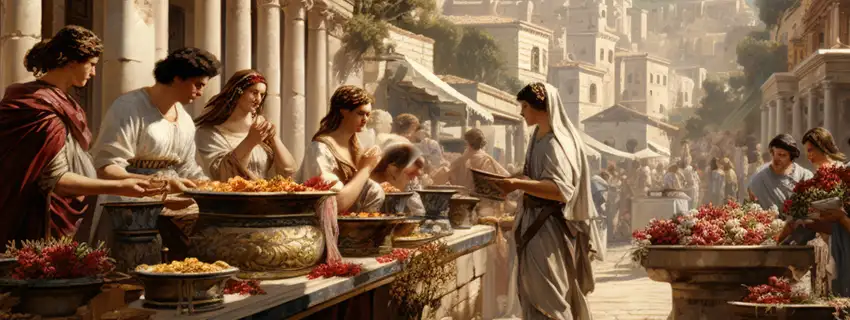
The origins of pizza: Egypt, Greece, Rome.
The history of pizza goes back more than three thousand years. All the civilizations of the past used focaccia, or flatbread, made from a dough of cereal flour (of various types), water, and various seasonings, as a fundamental source of nourishment.
The ancient peoples living around the Mediterranean did not shy away from this custom: from Egypt to Classical Greece to Ancient Rome, there was a proliferation of dishes quite similar, in composition and preparation, to modern pizza.
Read more
In Egypt, it was customary to celebrate Pharaoh’s birthday by eating flatbread seasoned with herbs. In Greece, the use of ‘maza’ (another type of flatbread) spread rapidly, as witnessed by Herodotus (who also passed on some Babylonian recipes) and Archilocus, the ‘soldier-poet’, who considered it a type of food particularly suitable for armies because of its practicality. In Rome, ‘placenta’ and ‘offa’, flatbreads made from barley (or wheat) flour mixed with water, were prepared: both formed the basis of the daily diet of all citizens.
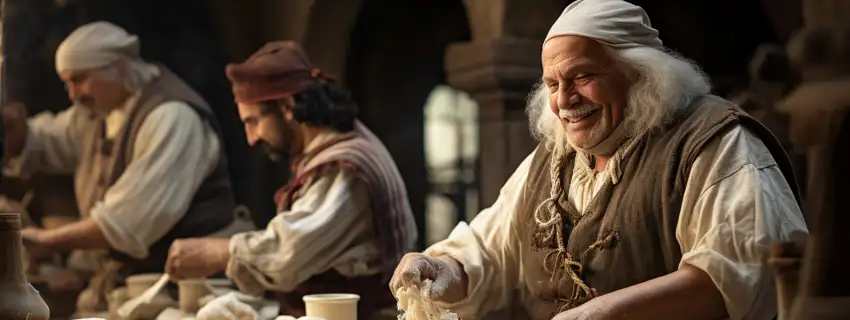
The origins of pizza: the Middle Ages and the Renaissance.
There are many traces of dishes similar to pizza during the Middle Ages and the Renaissance: different types of preparations, some particularly rich, intended for an aristocratic and wealthy public, others decidedly poorer, suitable for popular consumption.
The first use of the term ‘pizza’ is attested in the early Middle Ages. Over time, several variants of the word were born, indicating local culinary specialties, both sweet and savory, cooked in different ways.
Read more
The arrival of the Longobards into southern Italy, after the fall of the Roman Empire, was of fundamental importance to the development of the speciality as we know it today: these people introduced in fact the breeding of the buffalo, which, once settled in Lazio and Campania, provided the milk necessary for the first production of mozzarella cheese.
It should also not be forgotten that, thanks to the discovery of the New World, an ingredient arrived in Europe that would become of fundamental importance for pizza: the tomato. After some initial diffidence, this vegetable made its triumphant entry into Italian and especially Neapolitan gastronomy.

Margherita of Savoy: the Queen of pizza.
Margherita of Savoy, born in 1851 in Turin, was an extraordinary queen who won the affection of the Italian people. Daughter of the Duke of Genoa, she married the future King Umberto I in 1868, becoming Queen of Italy in 1878. An educated and sensitive woman, she passionately dedicated herself to charitable and social support works, promoting initiatives for children and women’s education. During her reign, she supported important humanitarian causes and was very close to the poorest classes. She maintained an elegant and compassionate reference figure, remaining queen until the assassination of her husband, in 1900.

The origins of pizza: the 18th and 19th centuries.
Between the 18th and 19th centuries, pizza became one of the most popular dishes of Neapolitan cuisine. In the beginning, it was sold along the avenues and the ‘vicoli’ (the typical narrow alleys) of the city: at that time, it was easy to meet shopkeepers who carried an oven on their heads, which they used to bring the hot pizzas to the customers, announcing their arrival with characteristic loud shouts. At the turn of the century, the habit of eating pizza not only in the street or at home, but also in the backeries, gave rise to the first pizzerias.
Read more
Over the years, these pizzerias evolved into what we know today, with the typical marble counter for working the dough, tables reserved for customers, and outdoor displays for selling to passers-by.
Much loved by the aristocracy (King Ferdinand II of Bourbon liked the pizzas of ‘Ntuono Testa in Salita S. Teresa) and even more by the common people, pizza became an everyday dish, suitable for both lunch and dinner.
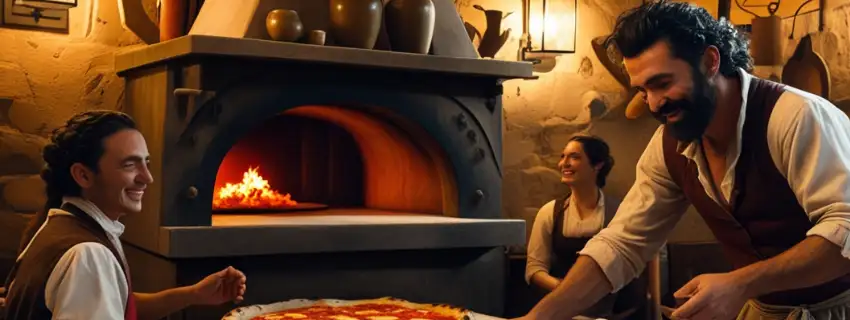
The origins of pizza: Brandi, the ‘home’ of the Margherita.
The birth of the first pizzerias coincided with the birth of the first ‘dynasties’ of Neapolitan pizza makers. One of the most famous was that of ‘Pietro e Basta Così’, a pizzeria founded in 1780. Among the many artists and intellectuals who became its loyal customers (also thanks to its location in the center of the city), Matilde Serao should certainly be mentioned. The famous chronicler used to stop in her carriage at the foot of the slope of Sant’Anna di Palazzo and order a pizza that she usually ate cold in the morning.
Read More
1889 was a very important year for ‘Pietro e Basta Così’, it was then that Raffaele Esposito, one of its chefs, invented a particular type of pizza to honor Queen Margherita on her visit to Naples: it was topped with tomato, mozzarella and basil, and was offered, along with others, to the sovereign and her husband. In this regard, a document has come down to us, signed by “devotissimo Galli Camillo, capo dei servizi di tavola della real casa”, dated June 1889, in which Signor Esposito is expressly thanked for the delicious pizzas offered and, in particular, for “the one with tomato and mozzarella”: it is therefore not surprising that this one was christened ‘Pizza Margherita’, the name by which it is still universally known.
Over the years, ‘Pietro e Basta Così’, the cradle of a specialty that had become famous all over the world, became the ‘Antica Pizzeria Brandi’, taking the surname of Maria Giovanna Brandi, Raffaele’s wife.
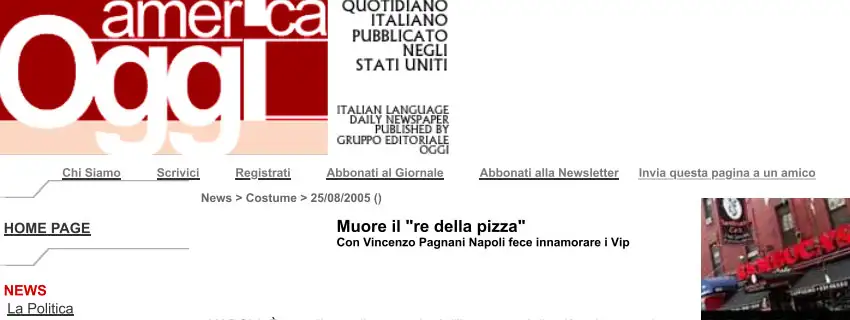
Vincenzo Pagnani: Maria Giovanna Brandi's ‘grandson’.
Vincenzo Pagnani was undoubtedly an important figure in the history of the Brandi Pizzeria and therefore in the history of Pizza Margherita. On the occasion of his sudden death in 2005, ‘America Oggi’, an Italian newspaper published in the United States, dedicated the following article to him in full.
Read more
He was the proud heir to the inventor of the most famous of pizzas, the Margherita. With Vincenzo Pagnani, considered the ‘king’ of the Neapolitan speciality and owner of the historic pizzeria Brandi in Chiaia, goes a piece of the Naples that knows how to fascinate with its history. but also with its flavours. He, the patron of the restaurant just a stone’s throw from Piazza del Plebiscito. who died of a heart attack at the age of 69, was the great-grandson of Maria Giovanna Brandi. wife of the Raffaele Esposito considered (the inventor of the pizza margherita. As a very young man, Pagnani inherited from Pasquale Brandi the small restaurant where he worked as a helper, and today that pizzeria is a fixed stop for anyone who wants to taste real Neapolitan pizza. Neapolitan tradition dates the birth of pizza back to the 18th century: in this era, in fact, in the homes of the poor, mothers, kneading flour, natural yeast and leftovers, invented pizza. The anecdote that made the Brandi pizzeria famous is well known: the fame of this seasoned bread spread so much that Queen Margherita of Savoy, on a visit to Capodimonte in 1889, asked to taste it. It was at this point in history that Raffaele Esposito appeared: inspired by the snow-white mozzarella. the pizzaiolo first created the ‘margherita’ pizza, named after the sovereign wife of Umberto I, hymning in its colours – the green of the basil, the red of the tomato and the white of the mozzarella – the Savoy tricolour. Over the years, Pizzeria Brandi has hosted numerous personalities from the worlds of politics, institutions and show business. The friendly owner of the restaurant has always welcomed his prestigious customers in a special way, surprising them with unexpected gifts: he offered Berlusconi, at dinner with Fini and Bossi, a large cake and, on the same occasion, even ‘allowed’ the Carroccio leader to sing ‘Maruzzella’. For Chelsea Clinton, who was in Naples with her father on the occasion of the G7, Pagnani prepared a porcelain filled with handmade chocolates as a souvenir. When the Savoy family returned to the city in 2903, Vincenzo Pagnani felt ‘excited’. In the Brandi pizzeria, one breathed euphoria and anticipation: it was also he who decided on a suitable décor for the pizzeria. The pizzeria rooms were decked out with two-coloured flags and the tables decorated with white, red and green flowers. All to receive Vittorio Emanuele, Marina Doria and Emanuele Filiberto and prepare, for the dynasty that invented the gastronomic invention, the margherita with the same recipe as more than a hundred years earlier. Pagnani, then interviewed. of the royals said: ‘They are exquisite people. They enjoyed themselves and even sang’. The Savoys are not the only crowned heads to have tasted Vincenzo Pagnani’s reshuffle. In 1997, Prince Albert of Monaco visited the 100-year-old Brandi pizzeria. Finally, the Presidents of the Republic could not miss the appointment with the product that has made Naples famous throughout the world. For Francesco Cossiga, the Brandi pizzeria closed to regular customers, reserving the room for the president. President Carlo Azeglio Ciampi, accompanied by his wife Franca. dined at Brandi’s in 1999 in the company of the then mayor Antonio Bassolino. After tasting the restaurant’s speciality, Ciampi was brought a fruit tart with the inscription ‘CA. Ciampi’. Needless to say whose idea it was.
(this content is the property of the newspaper ‘America Oggi’, published by kind permission)
Copyright information.
The images displayed in this page belong to Pizzeria Brandi, with the exception of:
Public Domain Images